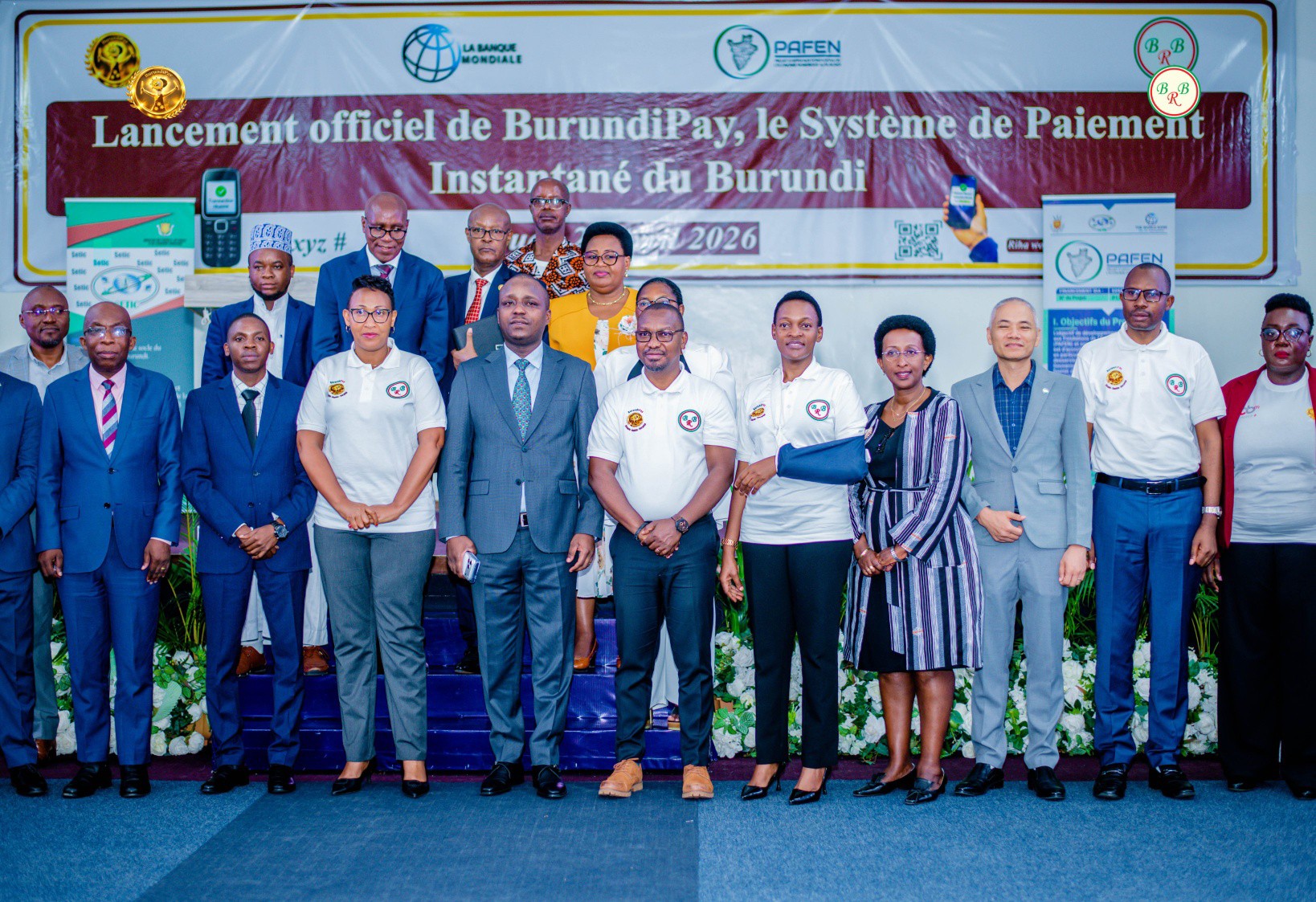
Burundi has stepped into the continental conversation on digital finance with the launch of BurundiPay, a national instant payment system unveiled on 23 April 2026 in Bujumbura by the Bank of the Republic of Burundi (BRB).
The platform allows users to send money and make payments in real time, 24 hours a day, seven days a week, from either a bank account or a mobile wallet — and crucially, across providers. For the first time, commercial banks, microfinance institutions, and mobile money operators in Burundi are connected within a single network. The days of withdrawing cash from one provider just to deposit it into another are, in principle, over.
At the launch ceremony, BRB Governor Edouard Bigendako described the system as a bridge rather than a replacement. “BurundiPay serves as a bridge for interoperability, enabling different players in the financial system to communicate with each other efficiently,” he said. The framing matters in a country where banks, microfinance institutions, and mobile money providers have historically operated in parallel, fragmented silos that locked ordinary users out of seamless transactions.
Libère Nduwimana, the central bank’s director of digital payments, framed the gain in everyday terms. “It is now possible to use money available in one’s bank account directly via a phone. This innovation helps avoid long lines and time losses.” Transaction fees may apply, he acknowledged, but the indirect savings — travel, queues, delays — are expected to outweigh them.
The design choices reveal who BurundiPay is built for. With internet penetration in Burundi sitting at around 30%, the platform works on both smartphones and basic feature phones via USSD codes. That decision — to meet users where they are rather than where digital strategy documents wish they were — is what could make or break adoption in rural areas, where most Burundians still live and most transactions still happen in cash.
The system is built on the ISO 20022 international financial messaging standard, the same backbone being adopted across global markets, which should ease integration with regional payment corridors and eventually with neighbouring EAC countries.
The launch was supported by the World Bank through the Digital Economy Foundations Support Project (PAFEN), and positions Burundi as the 22nd African country to deploy an instant payment system. It also follows a February 2026 milestone in which the BRB completed migration of its Automated Transfer System to the same ISO 20022 standard — a sign that the central bank has been quietly building the technical foundations for this moment for some time.
The longer-term vision is bold. Burundian authorities project that roughly 78% of the population will be using digital payment services by 2040, rising toward near-universal usage by 2060. Whether those projections hold will depend on the unglamorous fundamentals: pricing that ordinary users can absorb, network reliability in places where electricity itself is uneven, and public trust in a financial system that, until very recently, has not always served ordinary people well.
For East African development watchers, BurundiPay is also a story about regional integration moving in two speeds. While the EAC works to harmonise payment systems across borders, individual member states are building their own rails first — and the test will be whether those national systems can eventually plug into one another, or whether the region ends up with parallel networks that talk past each other.
For now, the milestone is real. A Burundian trader in Gitega can — at least in theory — receive a payment from a customer’s mobile wallet, send a portion to a supplier’s bank account, and pay a microfinance loan, all from a single phone, in seconds. That is not yet the lived reality for most. But the infrastructure to make it possible has now been put in place.